The Full Story
Daniel Flores Prudencio
Founder & Lead Strategist, ROVER, Querétaro, Mexico
Daniel’s work began with a challenge that most founders encounter until the cost is evident and too high to ignore: the business existed, but the brand did not yet have enough clarity to move on its own.
In 2013, he built his first brand, Poco a Poco Mezcal Artesanal, from an undefined starting point. The product had no name, no clear buyer, no established price. Bringing it into eight states across two countries required deciding what the product was, who it was for, why it should matter, and how it could be understood by people who had no context for it yet.
That experience taught him about marketing because the business needed marketing. The work that stayed with him was not the campaign work itself, but resolving the strategic tension that followed the project during it's life-cycle: how does a brand stand out and become memorable without the founder behind every push?
Over the next decade, that same tension appeared across different sectors and contexts. Real estate developments were being sold on features when buyers were responding to deeper motivations. Agency clients arrived with execution requests, but with strategy still unresolved beneath the surface. Technology companies tried to enter public-sector and regulated markets with strong products but unclear adoption narratives. Growing businesses had models that worked internally, yet struggled to explain their value to anyone outside the room.
The pattern became difficult to ignore. When work underperformed, the problem was usually diagnosed at the level of expression: the headline was weak, the channel was wrong, the budget was too limited, the creative needed refinement.
Sometimes those obstacles are indeed what hinders growth, but are rarely the root issue. More often, the business isn't clear enough for its own team and founders to communicate consistently, or for its customers to choose confidently among competitors.
ROVER Lab
ROVER was built to address structural business problems before execution begins. Its work follows a four-phase method: Diagnose, Define, Design, Deploy. The method exists to help founders and businesses move from unclear ambition into structured brand alignment, so that strategy, messaging, offers, customer experience, and execution are no longer compensating for one another, but reinforcing the same direction.
Daniel’s approach is grounded in human-centered design and strategy design, influenced deeply by IDEO U. The strategic perspective behind ROVER draws from the empirical marketing tradition of Byron Sharp and Jenni Romaniuk, especially their work on mental availability, distinctiveness, and brand growth. April Dunford and Marty Neumeier inform our understanding of positioning and the translation of strategy into expression. Margaret Mark and Carol Pearson’s work on archetypes supports our use of identity and symbolic coherence when relevant, while Philip Tetlock’s thinking on judgment and Jonah Berger’s work on transmission inform how ideas are evaluated, shaped, and carried into the market.
ROVER Lab's operating approach is also influenced by Darrell Rigby and Sarah Elk’s work on Agile and business transformation, while Simon Sinek, Seth Godin, and Dan Martell shape how we think about founders, long-term orientation, and entrepreneurial communication. The Moth’s narrative discipline informs how he helps founders move beyond explanation and learn to tell the story of what they are building with clarity and control.
Corporate Innovation
At Corporación Zapata, Daniel applied the same clarity-first method inside an established corporate environment.
He entered a small, siloed innovation department with no formal procedures and no project planning system. The opportunity was not simply to generate ideas, but to create the structure required for ideas to be evaluated, developed, and moved toward evidence. He built the operating model, KPI framework, and Agile/SCRUM cadence the department needed to carry uncertain concepts through a disciplined innovation process.
Under that structure, projects moved from problem definition to proof of concept and MVP, with more than 80% advancing to pilot. The portfolio included a gamified driver monitoring platform, a proprietary lubricant line, and the repositioning of a national used-truck marketplace.
The engagement ended with Daniel training the incoming leadership and handing off the active work, leaving the department with both the operating structure and the strategic cadence required to continue without dependency on him.
Market Entry and Public Sector
Daniel currently serves as marketing lead and advisor to Biocotech Americas, a multinational industrial composting company entering North America. In that role, he directs brand and market entry strategy, helping translate a technical and regulated offering into a clear adoption narrative for enterprise and institutional buyers.
He also designed a circular economy distribution initiative that advanced as one of three finalists in Querétaro’s SEDESU certification trial. The work required positioning environmental infrastructure not only as a sustainability concept, but as an operational and institutional system capable of being understood, evaluated, and adopted.
From 2019 to 2022, Daniel led the Mexico market-entry strategy for PSNA (Public Safety Network Americas), a US company introducing its NextGen 9-1-1 emergency data platform, 911Logix, to Mexico. His role centered on strategy and storytelling: defining the argument, structuring the case, and building the documents required to carry that case into government environments.
The initiative was supported by primary call volume and cost data from all 32 Mexican states and was received and evaluated by state and federal public security leadership in Querétaro and Mexico City. The work reinforced a central lesson in Daniel’s practice: in complex markets, the strength of the product is not enough. The case must be made clear enough for institutions to understand what is at stake, what must change, and why the timing matters.
Prior to ROVER, Daniel also rebuilt positioning for NAVY Training Center, a multi-location fitness franchise. The work included brand voice guidelines and a 12-week customer journey content strategy that became the foundation of its content system. For mPos Global, a Panamanian fintech, he led communications strategy for a multi-market payments launch, subcontracted through Madre Consulting.
Across these engagements, the work has remained consistent even when the industries have changed: define the center, clarify the value, structure the message, and build the system that allows the brand to move without constant reinterpretation.
Program Design
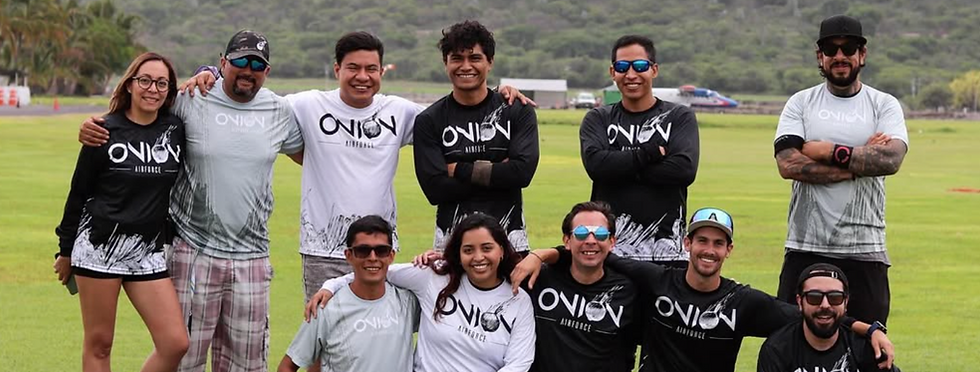
Daniel holds a Coach Rating from Skydive University, earned during his work founding The Onion Air Force in 2023. While skydiving may appear separate from brand strategy, the instructional model behind the certification directly informs how he designs learning systems for founders.
The certification is built around competency-based instruction. Progression is organized in stages. Each stage has explicit performance criteria. The student must learn to assess their own performance against a rubric before an instructor validates the work. The deeper concern is not only what happens during formal training, but what happens after it ends, when progression becomes self-directed and no one is checking every decision.
Many founders do not fail because they lack ideas, ambition, or effort. They fail at the point where external instruction ends and self-directed execution begins. They have consumed information, studied examples, and gathered advice, but they have not built the judgment system required to know whether their own work is clear, aligned, and ready to move.
The Brand Launch Program™
The BLP™ is structured as a staged progression system and a response to the main issues 75% of founders in Mexico and LATAM face when launching a business. Every exercise includes explicit pass criteria, the founder self-assesses before each checkpoint, no stage unlocks until the previous one has been passed. The goal is to develop the founder’s ability to recognize whether the brand is actually ready for deployment, create accountability and create an iterative system to test their business hypothesis through the early stages of launch.
The program runs for twelve weeks across five stages. By the end, the founder completes with a working brand and a 90-day launch plan, presented at graduation. The outcome is a founder with a stronger internal standard for clarity, alignment, and execution and a clear brand that reads equally to the founder, his partners and team, and his Ideal Customer Persona.
That is the throughline of Daniel’s work: helping founders and businesses stop carrying unclear strategy manually, and begin building systems that can hold direction, communicate value, and move with coherence.